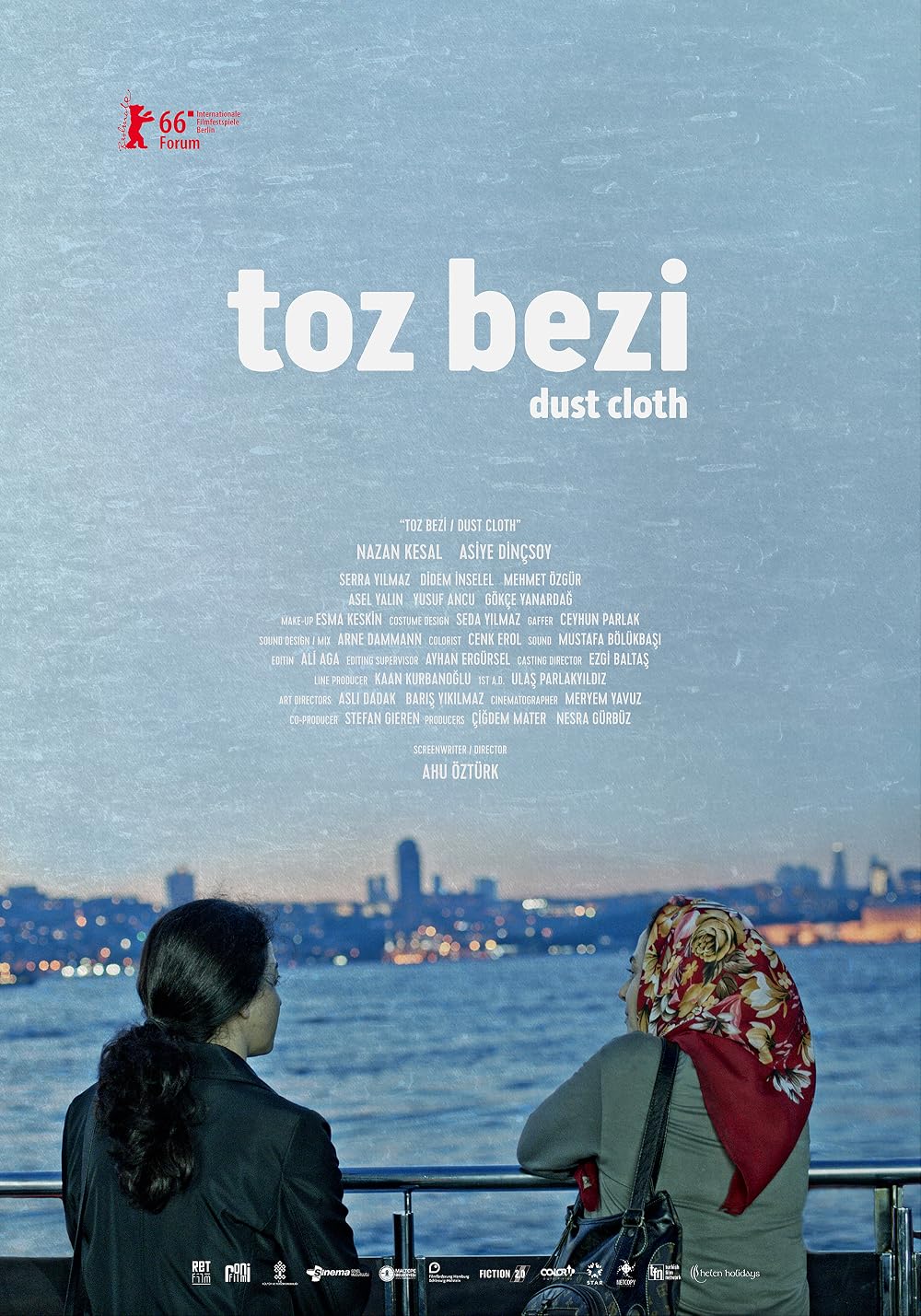
Spoiler note: The section covering the ending is collapsed below. If you haven’t seen the film yet, feel free to skip it.
Toz Bezi (Dust Cloth) tells the story of two women in Istanbul who make a living cleaning other people’s homes. But what I saw in the film was a sense of being trapped that goes beyond the hardships of work. Making ends meet, loneliness, identity, responsibility for children and not knowing how to position yourself next to others all pile up within the same life.
Credits
Original title Toz Bezi (Dust Cloth)
Director / Screenplay Ahu Öztürk
Year / Country 2015 · Turkey, Germany
Cast Asiye Dinçsoy, Nazan Kesal, Serra Yılmaz, Didem İnselel, Mehmet Özgür
Genre Drama
Runtime 98 minutes
Istanbul’s crowds are also an important part of this story. People rush somewhere, work, go back home. Within this movement, everyone carries their own problem. Something that looks small from the outside can take over the whole day, even the whole life, of the person living it. The film made me think partly from this angle.
Nesrin, played by Asiye Dinçsoy, is a woman living with her little daughter Asmin, trying to make sense of the absence of the husband who left her. Hatun, played by Nazan Kesal, is her neighbor and friend. Both work as day cleaners, but they cope with their circumstances in different ways. Hatun is saving money to buy a home in the neighborhood where she cleans, while Nesrin’s daily life is dominated more by uncertainty and loneliness.
Nesrin searching for her husband, for me, isn’t only about wanting to keep a relationship going. We also see the weight of being left alone with the responsibilities left behind by someone who has disappeared. She has to work, look after her child and keep her home running. The question of where her husband is persists amid all these necessities. Life goes on, but something unresolved is always standing behind her.
With Hatun, the conflict around identity and class position caught my attention more. She enters the lives of the homes she cleans, talks with the people there and listens to their problems. Even so, the film makes you feel that the relationship isn’t equal. Closeness shown in the middle of a conversation doesn’t by itself erase the distance between them.
At times I saw a condescending attitude in these encounters. Even though Hatun is inside the home, she isn’t accepted as someone who belongs there. It’s as if she’s expected to stay in a smaller space set aside for her within other people’s lives. This adds another burden, about how a person sees herself, on top of the physical exhaustion of cleaning work.
The question of identity doesn’t move separately from this inequality. Nesrin and Hatun being women, Kurdish and domestic workers together shapes their relationships with the people they meet. An academic study of the film focuses on exactly this link. It examines the inequalities the characters experience through gender, class and ethnic identity, and the different ways they develop to cope with them. The feeling I described as a conflict of identity has its counterpart in this reading too.
That said, Hatun and Nesrin sharing the same conditions doesn’t mean they can always understand each other. They support one another, but their relationship also has resentments, judgments and boundaries. This was one of the things that caught my attention. Solidarity isn’t shown as a flawless friendship in which all the differences between two people disappear.
Ending spoilers · click to open
This choice also makes the film’s ending more meaningful. Nesrin disappears and responsibility for Asmin falls to Hatun. For me, the heaviest thing while watching was the little girl being left behind. While trying to understand Nesrin’s helplessness, we can’t help thinking about the child’s situation too.
I don’t want to close Nesrin’s departure with a single explanation. Ignoring the burden on her and passing judgment easily, or treating what happens only as liberation, both feel incomplete to me. While showing a person reaching a point where she can carry no more, the film also puts in front of us what those left behind will do.
Aksu Bora’s piece in Altyazı reads this ending as Nesrin entrusting her daughter to a woman she can trust. This interpretation matches my thoughts on Hatun being unable to leave the child behind and taking on the responsibility. Still, for me the scene holds as much loss and uncertainty as trust. Asmin has someone to stay with, but her mother’s absence doesn’t go away.
At the end of the film we see Hatun blending into the evening crowd with the little girl. That was the image that stayed with me most. Istanbul’s movement goes on. The big change in their lives doesn’t stop the flow of the city. But Hatun taking Asmin with her keeps the child from being completely alone in that crowd.
I didn’t see an ending that solves every problem in this scene. Hatun’s own struggle to get by and her responsibilities continue. Even so, she makes room in her life for someone else’s child. For me, the film’s emotional payoff lies in that act.
There’s a similar emphasis in the actors’ interview about the film. Asiye Dinçsoy talks about how, in the neighborhood where they shot, women supported each other through their troubles, and about the existence of people who would take in a child in such a situation. This testimony is valuable for thinking about how the solidarity in the film plays out in everyday life.
For me, Toz Bezi was a film that made me think about how differently people living in the same city get by. We watch a woman who cleans other people’s homes trying to tidy up the mess in her own life, her loneliness and her relationship with her identity. In the end, what remains is the question of how much room one person can make for another amid all these burdens.
What worked for me
- A view that shows class, identity and gender together
- Women’s solidarity portrayed without idealizing it
- The performances of Asiye Dinçsoy and Nazan Kesal
- A memorable final image of disappearing into the crowd
What didn’t
- The sense of being trapped gets heavy at times
- The ambiguity of the ending may not land the same way for every viewer
Other reviews referenced
- Istanbul Modern — Dust Cloth film details
- Altyazı — Aksu Bora, “Films That Renew Hope: Toz Bezi”
- Bianet — interview with Nazan Kesal and Asiye Dinçsoy
- Zehra Nurdan Atalay and Ebru Thwaites Diken — academic study of the film