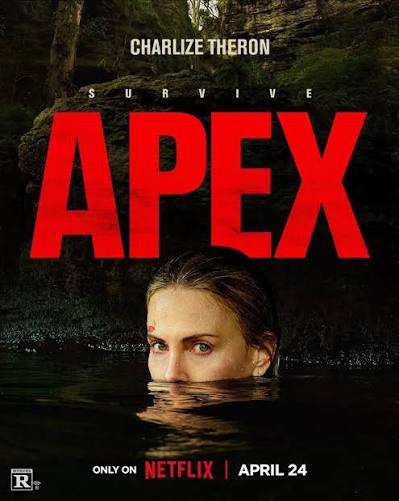
Spoiler note: Two sections covering the plot and the ending are collapsed below. If you haven’t seen the film yet, feel free to skip them.
Apex tells the story of a woman traveling alone in the wild who has to escape a killer who sees her as prey. But the first part I dwelled on in the film was the climbing sequence before the chase begins. In the trailer I watched, I hadn’t noticed how much weight this opening carries in the story. The film, though, builds the character’s relationship with danger and the loss she carries right here.
Credits
Director Baltasar Kormákur
Screenplay Jeremy Robbins
Year / Country 2026 · USA
Cast Charlize Theron, Taron Egerton, Eric Bana
Genre Survival thriller, action
Runtime 95 minutes
Platform Netflix
Sasha, played by Charlize Theron, and Tommy, played by Eric Bana, climb a mountain together and spend the night in a tent hanging off the edge of a cliff. For them this adventure has become a way of life in itself, yet from the outside it sits constantly next to the possibility of death. While Sasha’s excitement continues, we see Tommy starting to question the limits of this life.
Tommy wanting a calmer life caught my attention. Sharing the same activity doesn’t mean two people always want to take the same amount of risk. What still thrills one person can become exhausting or unnecessarily dangerous for the other. In that sense, the conversation in the opening gives emotional weight to the accident that follows.
Spoilers ahead · click to open
On my first viewing I questioned how much Sasha’s insistence and her way of taking risks contributed to the loss. But here it’s necessary to separate the guilt the character feels from the direct cause of the accident. On the way back, in worsening weather, an avalanche hits and Tommy falls. Sasha letting go of him becomes a moment where she has to prevent both of them from dying. Netflix’s explanation of the plot also supports this distinction. So summing up the scene as simply “the woman’s carelessness caused the man’s death” would be too definitive.
Even so, it’s possible to criticize the way Sasha assesses danger. I thought her self-confidence sometimes got ahead of the need to make decisions together. The film’s strong-woman narrative also turns into a question for me here. Does being physically capable and able to overcome hardship make every risk you take the right decision?
After Tommy’s death we see Sasha alone in Australia. Climbing, canoeing and harsh natural conditions remain part of her life. Seeing this journey only as a search for freedom may be incomplete. I also see a character holding on to the way of life she knows after her loss, perhaps finding it hard to stop and face what she’s been through. This is more my way of making sense of Sasha’s behavior than a definitive explanation of everything the film says outright.
Then Ben, played by Taron Egerton, enters the picture and the film turns into a more familiar survival thriller. A man who knows the area follows a woman traveling alone, steers her and eventually places her at the center of his own hunt. On top of the dangers Sasha willingly accepts in nature comes a threat deliberately created by another human being.
The difference here matters. A current, the weather or a rock face carry no personal intent. Ben, however, wants to watch Sasha’s fear and struggle. So the adrenaline the character seeks of her own will turns into a fear she can’t control. The distance between choosing danger and being subjected to someone else’s violence forms the film’s core tension.
After watching, I didn’t fully remember the matter of Ben consuming his victims. Netflix’s explanation confirms that the dried meat he prepares is made from his victims’ bodies. This detail pushes his view of people as prey to an even more extreme point. But what stayed with me from the film was less the scale of his evil than the pursuit that keeps forcing Sasha to run and fight back.
I don’t think the film offers anything very new in genre terms. A remote wilderness, a lone traveler, a stranger who seems helpful and a threat that gradually reveals itself are familiar elements. The Variety review also says the film relies more on how the action is executed than on surprises, and that the outcome isn’t hard to predict. But the same piece argues that this familiar structure manages to become an effective adventure.
My own assessment is a bit more reserved. I followed the story, and the relationship drawn between the loss at the start and the escape at the end caught my attention. But that connection didn’t turn the film into a truly exceptional experience for me. Part of why I gave it six is that most of the story moves within the familiar hunter-and-prey pattern.
Ending spoilers · click to open
The climb in the finale gains meaning through how it loops back to the opening. At the start, Sasha can’t save the person she loves and is forced to let him go. At the end, the person in front of her is the man who wants to kill her. This time, making him fall is a conscious decision she makes to secure her escape.
Two moves that look similar from the outside carry different moral and emotional meanings. In one, she can’t prevent a loss she didn’t want. In the other, she puts an end to the threat aimed at her. That’s why I don’t see the finale as “correcting a mistake” from the beginning. I read it as making visible the difference between the guilt Sasha carries from the first event and her right to protect her own life in the second.
This connection is reflected in viewer comments too. In a Reddit discussion about grief and guilt, people point out that the letting go at the start came from helplessness, while the one at the end came from choice. Some viewers read the entire chase as a struggle with grief. I find that symbolic reading possible, but I don’t think every detail of the film needs to be tied to a single meaning.
For me, Apex was a film that held my interest through the relationship between its opening and its finale, while following a more familiar thriller line in its middle section. It deals with the relationship with danger, the effort to go on after a loss and the decision to survive, all together. These elements are worth thinking about, but the film didn’t leave the kind of impact on me that would call for a higher score.
What worked for me
- A strong opening that builds the character’s relationship with danger and loss
- A meaningful link between the opening and the final climb
- The distinction between chosen danger and violence inflicted by someone else
What didn’t
- The middle settles into a familiar hunter-and-prey pattern
- A predictable trajectory
- Lacks the impact to become a truly exceptional experience
An interesting opening and finale; a more familiar thriller in between.
Other reviews referenced
- Netflix Tudum — explainer on Apex’s plot and ending
- Variety — Apex review
- Reddit — individual viewer comments on grief and guilt