Spoiler note: The section covering the outcome of the investigation and the families’ story is collapsed below. If you haven’t finished the series yet, feel free to skip it.
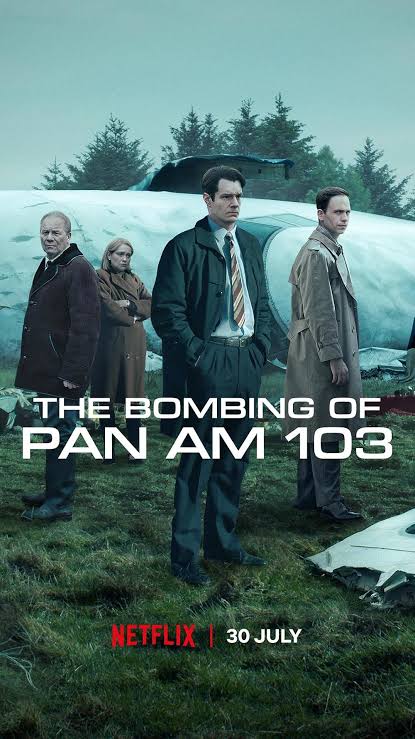
The Bombing of Pan Am 103, which I watched in October, tells the story of the international investigation that followed a real tragedy. Its subject is gripping, the performances are generally strong, and it makes you feel the weight of the event it covers. Even so, its occasionally static storytelling and a sense of disconnect between some of its storylines kept it from becoming a truly top-tier series for me.
Credits
Created by Jonathan Lee
Director Michael Keillor
Screenplay Jonathan Lee, Gillian Roger Park
Year / Country 2025 · United Kingdom
Network BBC One · Netflix
Episodes 6 episodes, limited series
Cast Connor Swindells, Patrick J. Adams, Merritt Wever, Peter Mullan, Eddie Marsan
Genre Crime, drama, history
On 21 December 1988, the Pan Am 103 aircraft broke apart over the Scottish town of Lockerbie when a bomb exploded in its luggage hold. All 259 people on board and 11 people on the ground were killed. The series follows the investigation carried out by Scottish police and American authorities after the attack, along with the impact of the losses on the families. The six-episode 2025 series is a dramatization based on real events.
One of the things that caught my attention most was how the investigation also turned into a struggle over jurisdiction and power. There’s an attack in which hundreds of people died. Even so, which institution would take the lead, whose information would be trusted and how the investigation would be run all keep mattering.
It’s understandable that the Scottish police take ownership of an event that happened on their soil. It’s also natural that the American side wants to join the investigation of an attack that killed its citizens. But in some encounters I sensed an air of superiority that got in the way of cooperation. The American officials having greater resources and technical means can also turn into questioning the competence of the local team.
It wouldn’t be right to treat England, Scotland and America as a rivalry between three completely independent countries. Scotland is part of the United Kingdom. The tension I saw in the series is shaped by the working relationships between Scottish institutions, London-based units and American officials. I also think the story’s weight lies on the Scottish and American sides.
My observation about this power struggle is echoed in outside reviews. The What’s on Netflix review counts the jurisdiction question and the way different teams clash and then come to terms among the series’ important elements. The same piece also notes that the heavy flow of information and the time jumps strain the pace of the story. In that sense it lines up with my thoughts on both the institutional tension and the sense of disconnect.
That said, I didn’t see the American contribution in the series as just a show of power. There are points where technical expertise moves the investigation forward. The explosives expert’s contribution in particular shows that an event of this scale requires bringing together the knowledge and means of different teams. This is also where one of the series’ more interesting sides emerges: institutions that rub against each other also need each other.
I liked Connor Swindells’ performance as Scottish detective Ed McCusker. In fact, his performance here was part of why I later watched William Tell. I had found his villain in William Tell too forced. Here I saw a more natural performance that fit the role better. I wouldn’t call it a huge performance, but it was one of the things that carried the series.
There are critics who think more positively about this than I do. Radio Times especially praises Swindells’ performance and argues that the series manages to keep its human connections within its broad investigative story. I agree with the positive view of the acting. But I didn’t feel the same fluency across the story as a whole.
The main problem with the series, for me, is that it doesn’t always strike a balanced relationship between the scope of the investigation and its dramatic flow. Different countries, officials, pieces of evidence and processes spanning years are covered. I can understand that these matter. But a piece of information being important in the real history of the event doesn’t automatically make it an effective scene on screen.
In some episodes the process moves forward, but as a viewer I can’t feel that sense of progress enough. At other points time passes and we arrive at a new stage. In these transitions, some of the story’s connections felt weak to me. It’s understandable that real investigations are slow and exhausting. Still, the rhythm of a series that tells that story has to be judged on its own terms.
Viewer reactions aren’t one-sided on this either. A comment I came across on Letterboxd sees the evidence-driven progress I found static as patient storytelling that builds tension without resorting to sensationalism. So the same choice created a sense of rigor for one viewer, while for me it sometimes created distance.
There’s a similar debate on social media about the American side being put in the foreground. Under a post on Reddit, someone voiced concern that the trailer might present the joint investigation as a story where “America saves the day.” But that comment is based on the trailer. So I don’t treat it as a full assessment made after watching the series, or as general viewer opinion. It only shows that the representation issue I noticed can catch other viewers’ attention too.
Spoilers ahead · click to open
I found the story of Kathryn Turman, who tries to help the victims’ families, valuable. The character, played by Merritt Wever, is a special assistant to Senator John Heinz and fights for the families to be supported and for the institutions to be more open. This part is a reminder that the investigation carries a responsibility broader than gathering evidence and finding suspects. The families being able to get information, to travel and to understand what happened is also part of the process.
On the question of justice, the feeling the series left me with was one of delay and incompleteness rather than a completed reckoning. Here it’s important to state the historical outcome correctly. It would be wrong to say no sentence was ever handed down. Of the two Libyan defendants, Abdelbaset al-Megrahi was convicted in 2001, while Lamen Khalifa Fhimah was acquitted. My criticism is about not getting a strong sense of closure that everyone responsible was uncovered and that the families’ expectations were fully met.
The series also makes you think about aviation security. Questions such as how luggage was accepted, how it was checked and who threat information was shared with make the systems behind the disaster visible. When we look at the security procedures we take for granted today, we also remember after which losses they took shape.
The Bombing of Pan Am 103 was a series I found worth watching for its subject and its performances. But I think it couldn’t always hold on to its dramatic unity while bringing together the institutional struggle, the details of the investigation and what the families went through. That’s why my score is 6/10. Honoring the weight of the real event and finding the series’ storytelling successful are, for me, two separate judgments.
What worked for me
- Storytelling that conveys the weight of a real tragedy
- Connor Swindells’ natural, well-suited performance
- Making the jurisdiction and power struggle between institutions visible
- The room given to the families through Kathryn Turman
What didn’t
- A pace that stalls at times
- Connections that weaken across the time jumps
- Investigative detail that doesn’t always become effective drama
Honoring the weight of the real event and finding the storytelling successful are, for me, two separate judgments.
Other reviews referenced
- World Productions — production details
- Netflix Tudum — cast and real-life figures
- What’s on Netflix — Ashley Hurst’s review
- Radio Times — James Hibbs’s review
- Letterboxd — an individual viewer review
- Reddit — discussion on the trailer and representation
- FBI — historical summary of the investigation