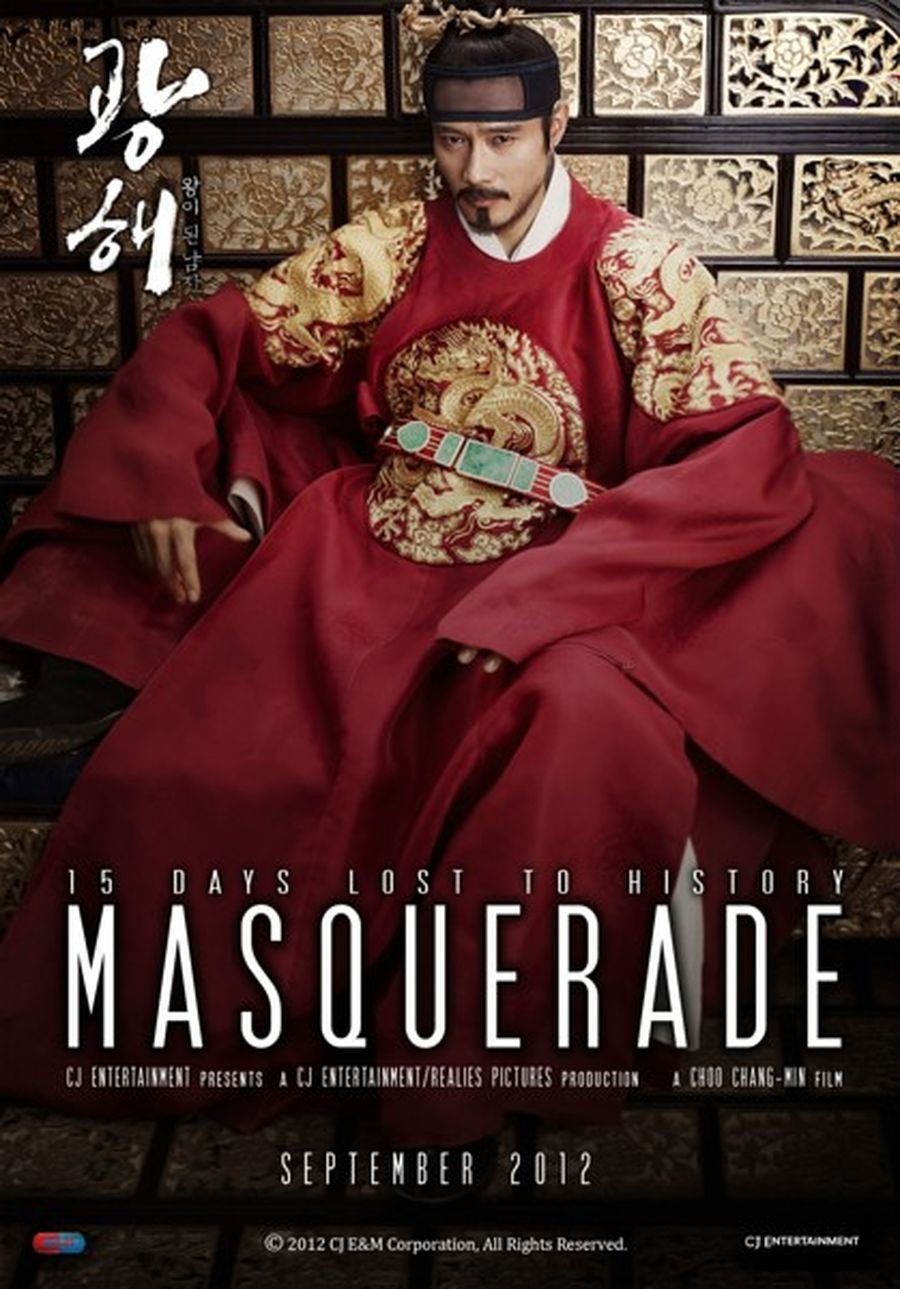
Spoiler note: Two sections covering the plot and the ending are collapsed below. If you haven’t seen the film yet, feel free to skip them.
I watched Masquerade while following Han Hyo-joo’s filmography. As the film went on, though, what really caught my attention was the difference between the two characters Lee Byung-hun plays. The same face, the same robes and the same throne serve two very different ideas of what it means to rule. One sees people as existing to serve him. The other, as he starts to learn what they live through, comes to understand the responsibility of the position he holds.
Credits
Original title 광해, 왕이 된 남자 (Gwanghae: Wang-i Doen Namja)
Year / Country 2012 · South Korea
Director Choo Chang-min
Screenplay Hwang Jo-yoon
Cast Lee Byung-hun, Ryu Seung-ryong, Han Hyo-joo, Kim In-kwon, Jang Gwang, Shim Eun-kyung
Genre Historical drama, comedy
Runtime 131 minutes
The film is built on a commoner, a performer, being put temporarily in the place of King Gwanghae, who lives in fear of assassination. At first Ha-sun simply plays a role for money. Over time, as he learns the rules of the palace, he also notices the injustices behind those rules. For me, the film’s power comes from how this change is built through small encounters.
What I initially found hard to accept was how extraordinarily alike the two men are. Beyond their faces, even small physical details match, which made the sense of coincidence a bit too big for me. You have to accept this premise for the film to move forward. The KPBS review also places the film alongside stories where a ruler and his double trade places, such as The Prince and the Pauper and Kagemusha. That familiar storytelling tradition explains the choice, but it doesn’t fully remove my initial reservation about believability.
Ha-sun coming from the common people doesn’t by itself prove he’ll be a good ruler. Anyone who holds power, wherever they come from, can change and abuse their authority. So what convinced me in the film wasn’t so much his origins as how he treats the people he meets. Listening to the servants, taking their fears seriously and caring about lives that are presented to him as unimportant make the character’s moral side concrete.
Spoilers ahead · click to open
His relationship with the fifteen-year-old maid is one of the strongest examples. Her family being torn apart by taxes and debt shows what life looks like outside the wealth of the palace. I also saw a link between her story and another fifteen-year-old girl Ha-sun had been unable to protect before. He faces a pain he couldn’t prevent in the past, this time from a position where he can help. That’s why his promise to find her mother isn’t just a casual act of kindness.
It also matters that, when he has to leave the palace, he gives her the money he was paid. A job he took on for a fee has turned into a sense of responsibility for someone else’s life. Even with his own future uncertain, he wants the promise he made to be kept.
The girl’s death by poison was one of the scenes that hit me hardest. It’s important to remember that a child has been left under threat here. None of the choices put in front of her are fair. Even so, the fact that she protects Ha-sun makes the human closeness he showed her visible in return. Ha-sun carrying her in his arms and failing to save her also shows the limits of his position. He can give orders and call for help, but he can’t stop the death of someone he cares about.
After this loss we also see the character’s anger and his desire to punish. So it would be incomplete to judge him only by his acts of compassion. Having the suspect tortured makes you think about how his grief seeps into the way he rules. For me, the character’s most important test comes at the point where he says he wants to be king. The words that follow, saying he doesn’t want it at the cost of someone else’s life, show the limit he places on his desire for power.
His relationship with his bodyguard develops in a similar way. Ha-sun tells the guard, who is preparing to kill him, that his life matters too. Later, the guard drawing his sword to defend him is the return on that relationship. Ha-sun going back to his wounded guard instead of running makes the loyalty mutual. The guard, in his final moments, clutching at Ha-sun’s feet with bloodied hands, was one of the film’s strongest images of respect and farewell.
The idea of valuing human life, built through the maid and the bodyguard, carries over to statecraft in the debate over aiding the Ming dynasty. While the court officials treat the soldiers’ deaths as part of their political obligations, Ha-sun asks about the lives of the people who would be sent. The empathy he shows individuals becomes a way of governing here. That said, I don’t treat the film as a historical document. The Korean Film Council also states clearly that the story, while drawing on real historical figures, is fiction.
I found Lee Byung-hun’s performance strong. He moves between Ha-sun’s shyness, humor, anger and growing sense of responsibility. Telling two people with the same face apart through their behavior is the main thing that carries the film’s central idea. KPBS highlighting the actor’s two performances and his shifts from comedy to emotional scenes matches my own impression.
With the queen, played by Han Hyo-joo, there are things I found missing. The character, who seems quite limited at first, gains importance as she grows closer to Ha-sun. Her brother’s pardon, her discovering who Ha-sun really is and warning him to flee build an emotional bond between them. Even so, I don’t think the finale returns to the queen’s story enough.
Ending spoilers · click to open
I wasn’t necessarily expecting a reunion here. But while the guard, the advisor and Ha-sun all get a final payoff, I would have liked to see how the separation affects the queen as well. The UnitedKpop review also says the queen’s backstory falls short and wonders what happens to her in the end. So the gap I felt resonates with another viewer too.
The deleted closing scene I watched after the film offers a brief return to this relationship. Ha-sun is once again telling stories in front of a crowd. His humorous storytelling reminded me of the scene where palace officials throw themselves to the ground to block his way. Then he sees the queen smiling in the crowd, and he smiles too. I don’t read this as a definite reunion, but it comes close to the emotional payoff I missed in the theatrical cut. According to news from the time, this section was planned for the ending and later removed in the edit.
The final farewell in the theatrical cut is powerful on its own. As Ha-sun drifts away in a boat, the advisor bows to him from the shore. There’s no longer any obligation required by rank. I read that gesture as the continuation of the respect Ha-sun earned in such a short time.
Despite the believability problem in its premise and the queen’s unfinished ending, Masquerade caught me emotionally. My real assessment is around 7.5. Since I can’t give half points on IMDb, I rounded up to eight. Valuing people not just in words but through relationships and decisions is the core reason the film stayed with me.
What worked for me
- Lee Byung-hun’s dual performance, telling two people with one face apart
- Valuing people built through small encounters and decisions
- The emotional scenes around the young maid and the bodyguard
- The advisor’s final bow from the shore
What didn’t
- The extraordinary resemblance between the two men strains belief
- The finale doesn’t return to the queen’s story enough
My real assessment is around 7.5; I went with 8.