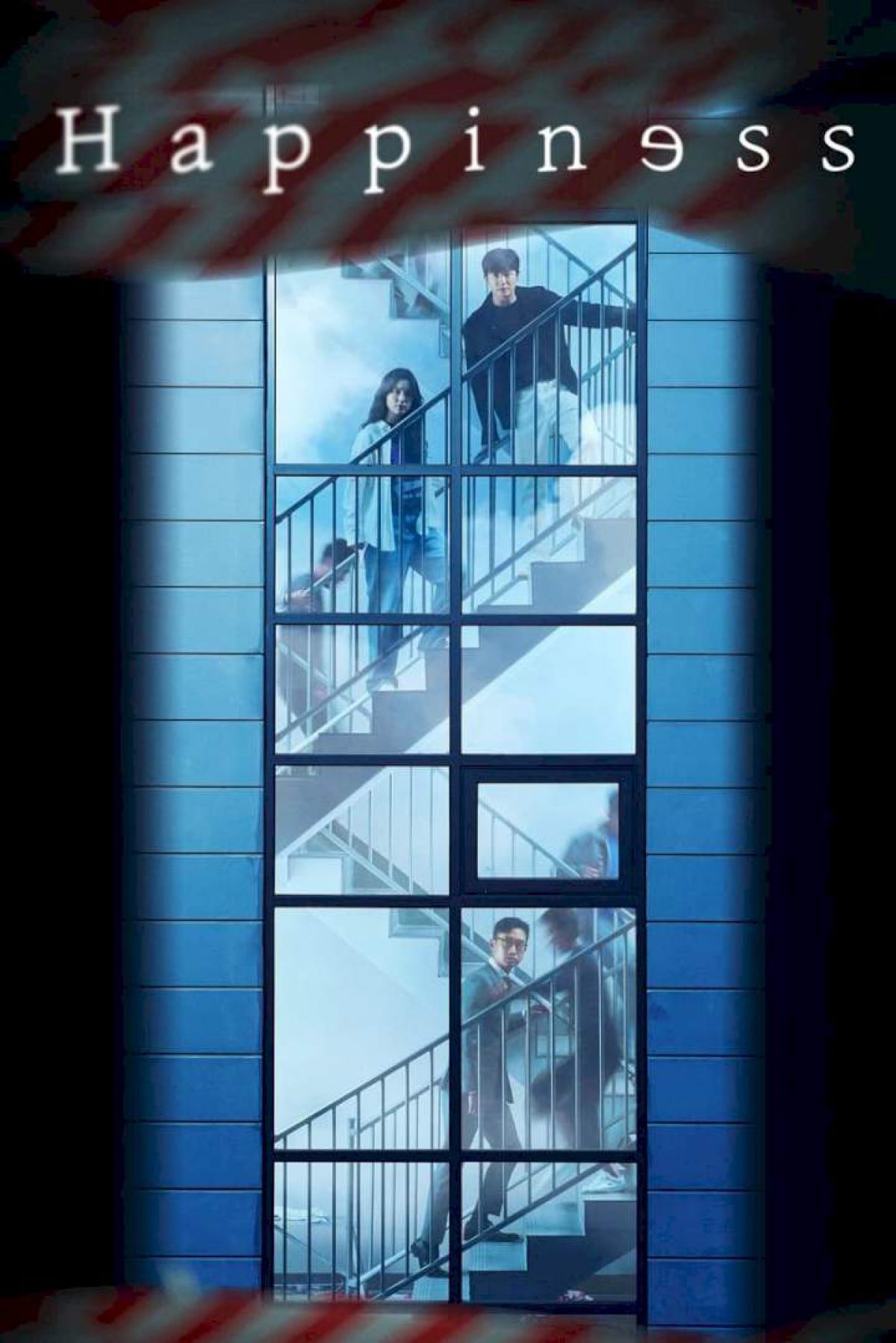
Spoiler note: The part covering the final episodes is collapsed below. If you haven’t finished the series yet, feel free to skip it.
Working through Han Hyo-joo’s projects, when I got to Happiness I found myself facing a familiar outbreak story: a world where people fall ill, turn violent, start suspecting one another and try to survive in a closed-off space. Since we’ve seen so many stories like this, whether the series could hook me depended on its characters and what they go through. By the end of its twelve episodes I found some of its ideas interesting, but I couldn’t connect with the relationship between the leads as much as I’d hoped.
Credits
Original title 해피니스 (Happiness)
Year / Country 2021 · South Korea
Network tvN
Director Ahn Gil-ho
Writer Han Sang-woon
Cast Han Hyo-joo, Park Hyung-sik, Jo Woo-jin
Genre Thriller, drama
Episodes 12
At the center of the series are SWAT officer Yoon Sae-bom and detective Jung Yi-hyun. The history between these two characters, played by Han Hyo-joo and Park Hyung-sik, goes back to high school. Yi-hyun’s scene on the school rooftop, after a knee injury ends his baseball career, marks the start of their relationship. Sae-bom pushing him toward the safety mat below shows, from their very first encounter, how direct and unconventional she is.
Years later, the two enter a contract marriage so that Sae-bom can qualify for an apartment. That decision, tied to the points system in the housing application, leads them to share a life in a new building. When the outbreak and the quarantine begin, the dream of owning a home turns into a fight for survival in a confined space.
There are several conflicts in that setup that could have worked: closeness from the past, a contract marriage, a shared life and a threat from outside, all coming together. Even so, I can’t say these elements formed a strong enough emotional whole for me. I can see the characters protecting each other and that there’s a bond between them. But I couldn’t feel the weight of that bond in every scene.
I found Han Hyo-joo more seasoned and settled into her role here. Sae-bom making decisions, acting directly in the face of danger and clashing with those around her when needed all come through in her performance. Still, looking at the series as a whole, her presence wasn’t enough to draw me in equally in every episode.
With Park Hyung-sik’s performance I felt a more noticeable distance. Yi-hyun’s physical presence, his identity as a cop and his authority in the building are clear. He can stop people, step into events and take on a protective role. But the character’s inner world didn’t reach me with the same clarity. I wanted to feel more of his fear, his love and his vulnerability.
Spoilers ahead · click to open
A character being able to manage events doesn’t automatically create a connection with the viewer. For me, Yi-hyun mostly remained the person trying to control the crisis around him. His own infection in the final episodes brings a more personal threat to the relationship and to the fight for survival. Even so, it couldn’t fully close the distance that had built up by then.
I felt a similar limitation in the outbreak story itself. The spread of the disease, transformations, hidden symptoms, the possibility of immunity and the search for a cure are all familiar elements of the genre. Reusing them is understandable. Within that familiar structure, I was hoping the characters or the events would give me a different experience. In some episodes, though, I felt the same suspicions and conflicts simply being recycled.
The side of the series I found more interesting was the class hierarchy inside the building. The divide between those living on the upper floors and those on the lower floors doesn’t disappear even in the face of shared danger. The woman trying to become the building’s leader constantly feeding that divide is especially striking. Living on an upper floor is presented as if it also justified the right to make decisions.
Here the building’s physical layout makes visible how people see one another. Those living higher up place themselves in a more authoritative, more valuable position, while the say of those below is narrowed. Being locked in the same building and fearing the same disease isn’t enough to make them act together. The crisis opens new ground for keeping existing claims to privilege alive.
In that sense, Happiness builds a social structure worth reading at the scale of an apartment block. Throughout the quarantine there’s a struggle over who decides, who can be trusted and how resources are shared. A personal review published on Monash University’s site also puts the divide between the owners on the upper floors and the public-housing tenants below at the center of the series’ class critique. That reading matches the hierarchy I noticed in the would-be leader’s behavior.
That said, understanding a point the series is making didn’t mean I found its dramatic handling fully successful. I can see the power struggle in the building. But some characters repeating similar attitudes sometimes weakened the idea’s impact for me. As selfishness and self-interest became more obvious, it also got easier to predict how characters would react.
Other reviews reflect this too. The review at Montasefilm feels the intriguing opening is weakened by repetitive conflicts and logic problems. One of the viewer comments collected by KORB also mentions that some scenes feel repetitive, though the same comment says the leads’ appeal overshadows that issue. In my experience, the bond between the actors wasn’t strong enough to cover those gaps.
I’m also aware that I part ways with positive takes on the leads. Teen Vogue especially praises the tenderness and vulnerability in Park Hyung-sik’s performance and his chemistry with Han Hyo-joo. In the same character, I more easily saw authority and protectiveness. I couldn’t feel the emotional side as strongly as that review does.
After Happiness ended, what stayed with me most was the order of the building. People defending their floors, their property and their privileges even in the face of a shared disaster was one of the series’ most meaningful conflicts. The progress of the outbreak and the central relationship, by contrast, didn’t have the same effect on me.
I found Han Hyo-joo’s performance more successful than the male lead’s. But across the series as a whole, I couldn’t form an emotional bond strong enough to lift it above a familiar outbreak story. I watched some of its scenes and social observations with interest; in some episodes, I was waiting for the events to pull me back in.
What worked for me
- The class hierarchy built around the building’s floors
- Han Hyo-joo’s seasoned, settled performance
- Its social observation about who gets to decide in a crisis
What didn’t
- The bond between the leads never feels weighty
- Yi-hyun’s inner world stays out of reach
- It doesn’t move beyond familiar outbreak tropes
- Repetitive conflicts and predictable reactions
My score for all 12 episodes.