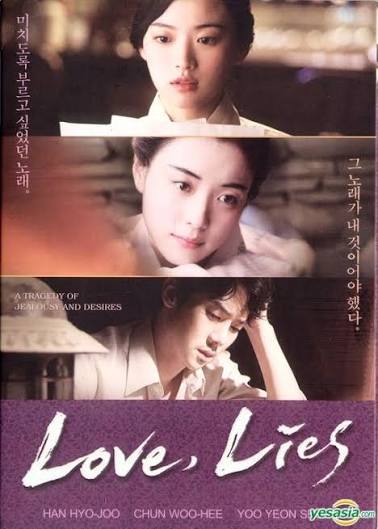
Spoiler note: Two sections covering the plot and the ending are collapsed below. If you haven’t seen the film yet, feel free to skip them.
In Han Hyo-joo’s filmography, Love, Lies stands apart in both its character and its atmosphere. After watching her in likable, protective or emotionally approachable roles, it caught my attention to see her here as a more selfish, jealous woman who makes destructive choices. Throughout the film I could understand the break the character goes through. Even so, I found some of the story’s key transitions weak.
Credits
Original title 해어화 (Haeeohwa)
Year / Country 2016 · South Korea
Director Park Heung-sik
Screenplay Ha Young-joon, Jeon Yun-su, Song Hye-jin
Cast Han Hyo-joo, Chun Woo-hee, Yoo Yeon-seok, Park Sung-woong
Genre Period drama, romance
Runtime 120 minutes
Set in 1940s Korea under Japanese colonial rule, the film tells the story of the friendship between two young women who grew up together. So-yul and Yeon-hee train in traditional music while also being drawn to a changing music world. When So-yul’s lover, the composer Yoon-woo, turns toward Yeon-hee’s voice and then toward Yeon-hee herself, a conflict begins that weaves friendship and artistic rivalry together.
For me, the most interesting side of the story is that So-yul isn’t untalented. She excels at traditional singing, she’s trained and she has reasons to be confident. But what she’s good at doesn’t bring her the singing career she longs for. Yeon-hee, on the other hand, stands out with a voice that moves listeners in the popular songs of the time. Through that difference, the film shows that success in one field may not lead to the same result when conditions change.
So-yul turning to the new music world doesn’t solve the problem either. There, she doesn’t get the response her friend gets. Watching it, I thought about how not everyone can succeed equally in every field. Knowing a traditional style well and reaching listeners in a different kind of music require different fits. As So-yul tries to find her own way, she becomes more and more fixated on Yeon-hee’s success.
And the rivalry isn’t only about music. The man she loves choosing her friend turns a professional disappointment into a personal loss. From So-yul’s point of view, it feels as if her love and her future are being taken from her at the same time. I can understand that feeling. But the choices she makes afterwards show her sense of injustice turning into a desire to control other people’s lives.
Spoilers ahead · click to open
That’s what sets Han Hyo-joo’s role apart. Because she’s been hurt, So-yul doesn’t become a character the audience can stand behind unconditionally. She tries to block her friend’s career, uses her closeness to political power to her own advantage and harms those around her for the life she wants to have. After the roles I’m used to seeing her in, watching her play a character like this was one of the film’s most striking aspects for me.
So-yul’s relationship with the Japanese police chief is also part of that search for power. Thanks to that closeness she can get doors opened, get recordings made and try to carve out a place for herself in the music world. But those opportunities can’t buy the audience’s love. The gap between the power she can gain and the artistic response she longs for keeps growing.
Still, I wasn’t fully convinced by how the film builds its love triangle. I would have liked to see more of how Yoon-woo’s feelings change and what Yeon-hee is thinking as she grows closer to her friend’s lover. While the story makes So-yul’s jealousy and destructive behavior very clear, it doesn’t give the other two the same time to face their own decisions.
Here I also agree with another review. Yonhap’s review finds Yoon-woo’s shift in affection from So-yul to Yeon-hee unclear, and says the film doesn’t explore enough why Yeon-hee shows no real pangs of conscience about her relationship with her friend’s lover. For me as well, that gap made it harder to approach every side of the conflict with the same depth.
The period atmosphere, meanwhile, adds weight to the story. The effort to build a music career unfolds amid the violence of colonial rule and people’s dependence on the powerful. The power So-yul thinks she is using gradually becomes a system she can’t escape herself. Here the film’s historical setting and its art world feed each other. Even so, the sheer intensity of the disasters that unfold couldn’t fully make up for the steps I felt were missing in the characters’ development.
Ending spoilers · click to open
The record scene at the end of the film stayed with me longer. The aging So-yul introducing herself as Yeon-hee suggests she still hasn’t escaped her friend’s shadow. Then her own recording of Love, Lies surfaces. The man in front of her, without knowing who she really is, notices the sorrow in her voice and the beauty of the song.
I don’t read this scene only as the relief of a woman finally receiving praise. So-yul had wanted to be recognized, loved and successful for much of her life. What matters more to me here is that she can hear the value of her own recording years later. Through someone else’s response, she notices something she couldn’t see in the past.
In that recording, her traditional singing, the composer’s song and the pain she lived through come together. Loss, anger and disappointment find their voice. The artistic effect she spent the whole film trying to reach perhaps emerges most where she sings her own pain. But by the time she realizes it, too much time has passed. That’s why the ending left me less with a sense of success than with a realization that came too late.
The Korea Times also notes, in discussing the film’s jealousy, love and musical rivalry, that the story is built toward that final moment. In my experience too, the last scene was stronger than some of the film’s earlier parts. Still, a powerful ending didn’t fully make up for the gaps I felt in how the relationships are built and how the characters change.
I hovered between a six and a seven for Love, Lies and went with a six. What stays with me is Han Hyo-joo playing a character unlike the ones I’m used to, the period atmosphere and the sorrow carried by that final record. On the other hand, I wish I could have followed the breakdown of the friendship and the love more deeply. The film stays with me as a story that reaches a powerful final scene but leaves some important emotional steps out along the way.
What worked for me
- Han Hyo-joo in an unusual, selfish and destructive role
- The idea of talent losing its footing as conditions change
- An art world intertwined with the colonial-era atmosphere
- A final record scene that lingers
What didn’t
- An unconvincing love triangle
- Too little room for Yoon-woo’s and Yeon-hee’s inner lives
- The intensity of the disasters can’t cover missing character steps
My honest score sits between 6 and 7; I went with 6.