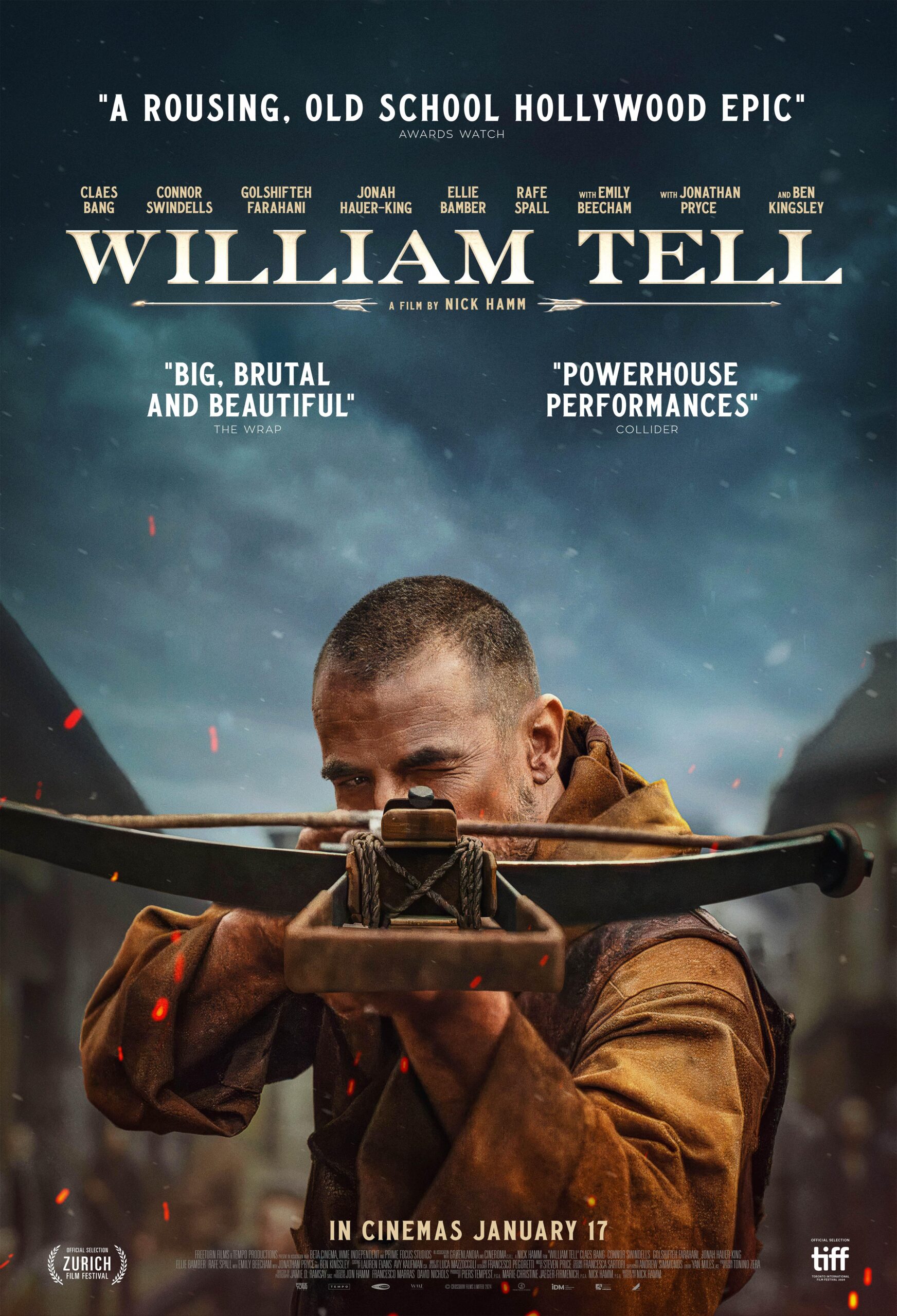
Spoiler note: The section covering the film’s most famous scene is collapsed below. If you haven’t seen the film yet, feel free to skip it.
My main reason for watching William Tell was Connor Swindells. I liked him in the series The Bombing of Pan Am 103, so I wanted to see him in a different kind of role. But Nick Hamm’s film couldn’t pull me into its story beyond my interest in the actor. All the pieces of a grand heroic tale seemed to be in place: cruel rulers, oppressed villagers, a man trying to protect his family and a rebellion that keeps growing. Even so, I never found the excitement or the emotional weight I was hoping for.
Credits
Original title William Tell
Year / Country 2024 (festival) · 2025 (release) · United Kingdom, Italy
Director Nick Hamm
Screenplay Nick Hamm (from Friedrich Schiller’s play)
Cast Claes Bang, Connor Swindells, Golshifteh Farahani, Ben Kingsley, Jonathan Pryce
Genre Historical action, drama
Runtime 133 minutes
Some sources list the film as 2024, others as 2025. That’s because it played festivals in 2024 and opened in cinemas in 2025. The story turns the William Tell legend and Friedrich Schiller’s play into a new historical adventure.
Tell is drawn into events through the violence an oppressive tax regime brings into the villagers’ lives. An assault on a woman, her husband killing the tax collector and then having to flee pull Tell into the conflict as well. What starts with Tell helping that man gradually grows into a much larger story of resistance.
That setup could have carried real dramatic weight. Someone who wants to stay away from violence being forced to take a side in the face of what others are suffering is a strong conflict. But I didn’t feel the emotional weight of that transformation enough. Events carry Tell toward rebellion, yet we never get equally close to how he changes along the way. I can follow why each new clash begins; his place within it, though, is something I’m mostly asked to accept because the script steers me there.
Gessler, played by Connor Swindells, stands on the other side of that problem. The film leaves very little ambiguity about his cruelty. His behavior, his looks and the pleasure he takes in humiliating people are constantly pushed to the front. For me, that heavy emphasis sometimes made the character feel forced rather than threatening. In Swindells’ performance, I noticed the effort to make evil visible more than I noticed the character himself.
Spoilers ahead · click to open
Gessler having an apple placed on the head of Tell’s son and forcing the father to shoot it is the story’s best-known and heaviest scene. In a moment like that, the tension should rise from the father’s fear and the arbitrary cruelty of the power facing him. But because Gessler’s showy villainy up to that point had already pushed me away from the character, I couldn’t fully get caught up in the scene. Of course I understand how horrifying the situation is. The way the film shows it just didn’t have the effect it was going for.
Looking at the cast, I see well-known, experienced names. Even so, the combined effect of the performances never gave me the feeling of watching a great historical epic. Claes Bang’s Tell also didn’t become a strong enough center for me. A man’s reluctance to fight, his silence or his weariness can be compelling. Here I wanted to feel more of the personality underneath those traits, the kind that would make others follow him.
The film’s visuals created a similar distance. While watching, I kept thinking I was seeing a much lower-budget production. That wasn’t a guess about the real budget; it was the impression the scenes, the action and the overall presentation left on me. In fact, the press reports a production budget of around 45 million dollars. Learning that figure made the limits I felt on screen even more noticeable.
Looking at other reviews, I found echoes of that impression. The review in Senses says the film’s digital, artificial look recalls a low-budget TV production, and also criticizes the fight choreography, the dialogue and the uneven pacing. At the same time, the same writer likes Claes Bang’s performance and the use of physical locations. So where we overlap is less about all the performances and more about a sense that the presentation falls short.
Radio Times, for its part, feels the lead performance doesn’t match the film’s scale, that the supporting characters are underdeveloped and that the script leans on familiar formulas. That’s close to my own sense of not connecting with the hero. The review does, however, praise Swindells’ take on Gessler. A performance I found too pronounced and artificial can be, for another viewer, what lifts the film’s energy.
Film Inquiry shows a similar split. The review likes Gessler but criticizes how the story is stretched with so many characters and intrigues, saying Tell at times ends up in the background of his own story. I also think that, in trying to grow bigger, the film doesn’t deepen the person at its center enough.
While watching, I was reminded of Robin Hood with Kevin Costner. For me, the hero, the adventure and the emotional connection carried each other in that film. I was looking for that same sense of being swept along in William Tell. Before any faithful recreation of historical details or of the legend, I wanted to be able to step inside the struggle being told. Here, despite all the events showing oppression and resistance, I couldn’t get close enough to the people living through them.
The fact that William Tell’s historical existence is disputed isn’t, on its own, a problem in judging the film. Legends can be retold in different ways. What matters to me is whether the chosen telling builds a convincing world and characters on its own terms. In this adaptation, I felt the sense of heroism was being built through the sheer size of events and the excess of the villain.
I also considered giving it a four. In the end I put a five on IMDb. William Tell, which I started out of curiosity to see Connor Swindells in a different role, left me largely disappointed. What stays with me is the absence of a film that could have made its central hero and his struggle feel much stronger.
What worked for me
- A strong dramatic setup: a man who shuns violence forced to take a side
- A well-known, experienced cast
- An attempt to turn the legend and Schiller’s play into a new historical adventure
What didn’t
- Tell’s transformation never carries real emotional weight
- An overemphasized Gessler who feels forced rather than threatening
- The apple scene doesn’t build the tension it should
- Visuals that feel like a much smaller production than the budget suggests
My honest score sits between 4 and 5; I put a 5 on IMDb.