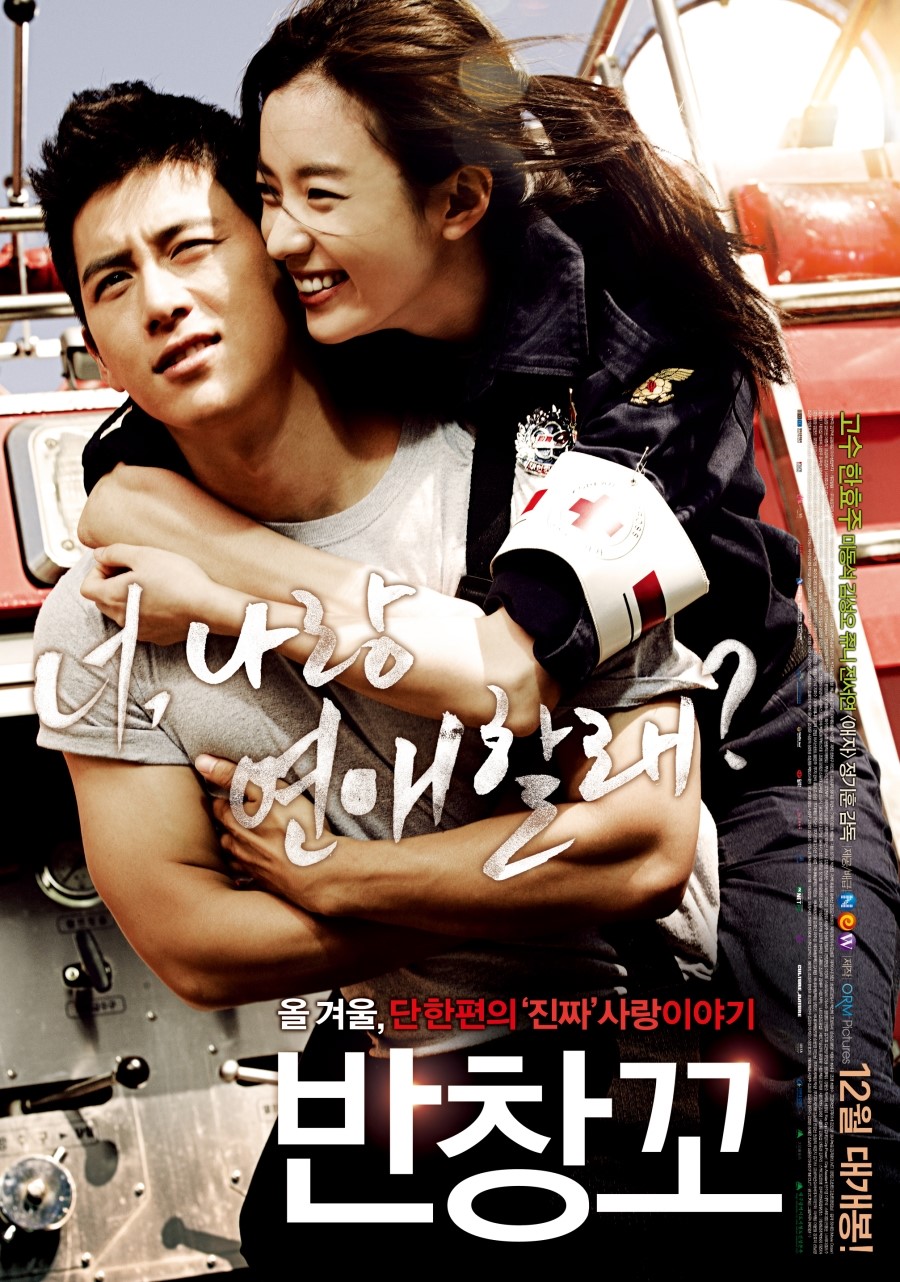
Spoiler note: The section covering the characters’ pasts and the ending is collapsed below. If you haven’t seen the film yet, feel free to skip it.
Working through Han Hyo-joo’s filmography, I’m noticing that her romances don’t all land with me the same way. In Always I was able to connect with the characters. I liked the unusual idea and the emotional side of The Beauty Inside, despite some flaws. Love 911, though, is a film whose romance I never fully managed to believe in.
Credits
Original title 반창꼬 (Banchangkko)
Year / Country 2012 · South Korea
Director Jeong Gi-hoon
Screenplay Jeong Gi-hoon, Park Sang-min
Cast Go Soo, Han Hyo-joo, Ma Dong-seok, Kim Sung-oh
Genre Romantic comedy, drama
Runtime 120 minutes
Two characters sit at the heart of the film. Mi-soo is a doctor facing a lawsuit over a misdiagnosis that threatens her career. Kang-il is a firefighter who lost his wife and carries the guilt of that loss. What first brings them together is Mi-soo’s attempt to save her own skin: after Kang-il is attacked by the patient’s husband, she tries to persuade him to press charges so she can gain an edge in the case.
That setup could have created a strong conflict for character development. A doctor focused on her own future being forced to face other people’s pain is the groundwork for a meaningful transformation. Likewise, a man still tied to the wife he lost slowly opening up to someone new deserves careful handling. The film wants to tell both of these transformations. My problem is that the steps in between aren’t built convincingly enough.
For a long time, Mi-soo’s approach to Kang-il plays out like a game. Her attempts to win him over, following him around and refusing to give up despite being turned down make up a big part of the comedy. But I struggled to watch that approach turn into a genuine emotional bond. Her persistence is clear; why and how he grows attached to her never becomes equally clear to me.
Characters who dislike each other at first are a familiar choice in romantic films. Here, though, the weight of that initial self-interest means the love that follows needs stronger groundwork. Mi-soo’s turn toward taking responsibility matters in that sense. Still, looking at the relationship as a whole, I have to say some of their moments of closeness felt less like the natural result of what happened and more like the script moving on to its next stage.
Spoilers ahead · click to open
Kang-il’s past also plays a big role. Losing his wife, the guilt of not being there for her, and the way he puts himself at risk on dangerous missions are all tied together. Even so, the flashbacks didn’t always give me the clarity I needed to understand him. With the details of his wife’s death and some of the memories they shared, I had trouble fully grasping the emotion the scenes were carrying.
The scene where he clings to the stool is an example. When it cuts to a memory he shared with his wife, you can sense why the object matters to him. But while I was trying to work out the physical details of the scene and the context of the conversation, I drifted away from its emotional impact. Showing a memory in fragments can be meaningful. In my viewing, though, some of the pieces didn’t quite fit together.
I felt a similar distance in the final act. The breakup scene, where Mi-soo confesses her love and Kang-il doesn’t return it, is an important turning point for the relationship. The dangerous rescue operation that follows, and his being trapped under the rubble, force him to face his feelings. It makes sense that a brush with death would change someone’s priorities. Still, that turn felt too fast to me.
For the same reason, the run and the reunion after the collapse didn’t have the impact the film was aiming for. Kang-il going to the hospital to find Mi-soo, learning she has resigned, and the two of them meeting on the road complete the romantic finale. But I was still wondering how these two people had actually bonded. The momentum and emotional intensity of the ending couldn’t make up for what I felt was missing in how the relationship developed.
Mi-soo having joined the rescue team in the final scene is another transformation the film rushes past. That choice makes the change in her life visible. But skimming over how she got there adds to the narrative gaps I felt throughout the film. In the version I watched, some on-screen text wasn’t translated, which also made the time jumps harder to follow. So I don’t want to blame every uncertainty about how much time had passed directly on the script.
As for Han Hyo-joo, I can see her trying out a livelier, bolder and at times provocative character. Still, I found her performance in Always more affecting. There, I connected much more easily with the character’s vulnerability and with the relationship. In Love 911, the distance I felt toward Mi-soo’s behavior also limited the impact her performance had on me.
Looking at other reviews, I found similar views, especially about how the relationship develops. At AsianMovieWeb, Manfred Selzer likes the leads’ chemistry and the film’s humor, but notes that the relationship sometimes develops too abruptly, that the believability of some events is questionable, and that the ending is overly sugary. My objections also center largely on those transitions.
Myong Choi at Honolulu Magazine, meanwhile, finds the premise and the situations the characters face far from realistic, and feels the film leans on the impact of individual moments rather than building a cohesive story. Even so, he says he loved it thanks to the leads’ charm and its emotional pull. That review shows why the same flaws can lead different viewers to different conclusions.
A Letterboxd review by a viewer named Dushine is closer to my own experience. They write that they didn’t find Kang-il’s growing interest or Mi-soo’s transformation convincing enough. It’s only one viewer’s take, but it suggests the things that bothered me were felt by others too.
I found Love 911 more successful than Postman to Heaven. Even so, I couldn’t really take its love story to heart. The film creates plenty of events to bring its characters together. I wanted to see, more clearly and more naturally, the change those events leave in their feelings.
My personal rating sits between a five and a six. Since IMDb doesn’t allow half points, I went with a six. What stays with me is less the idea of two wounded people healing each other, and more the feeling that making their closeness believable needed a little more time and more careful transitions.
What worked for me
- A strong opening conflict for both the doctor’s and the firefighter’s arcs
- The idea of two wounded people healing each other
- Han Hyo-joo trying a livelier, bolder character
What didn’t
- An unconvincing shift from self-interest to love
- Fragmented flashbacks that don’t quite explain the character
- Emotional turns in the finale that come too fast
- A final-scene transformation that’s rushed past
My honest score sits between 5 and 6; IMDb doesn’t allow half points, so I went with 6.