Spoiler note: The section covering the plot and the ending is collapsed below. If you haven’t seen the film yet, feel free to skip it.
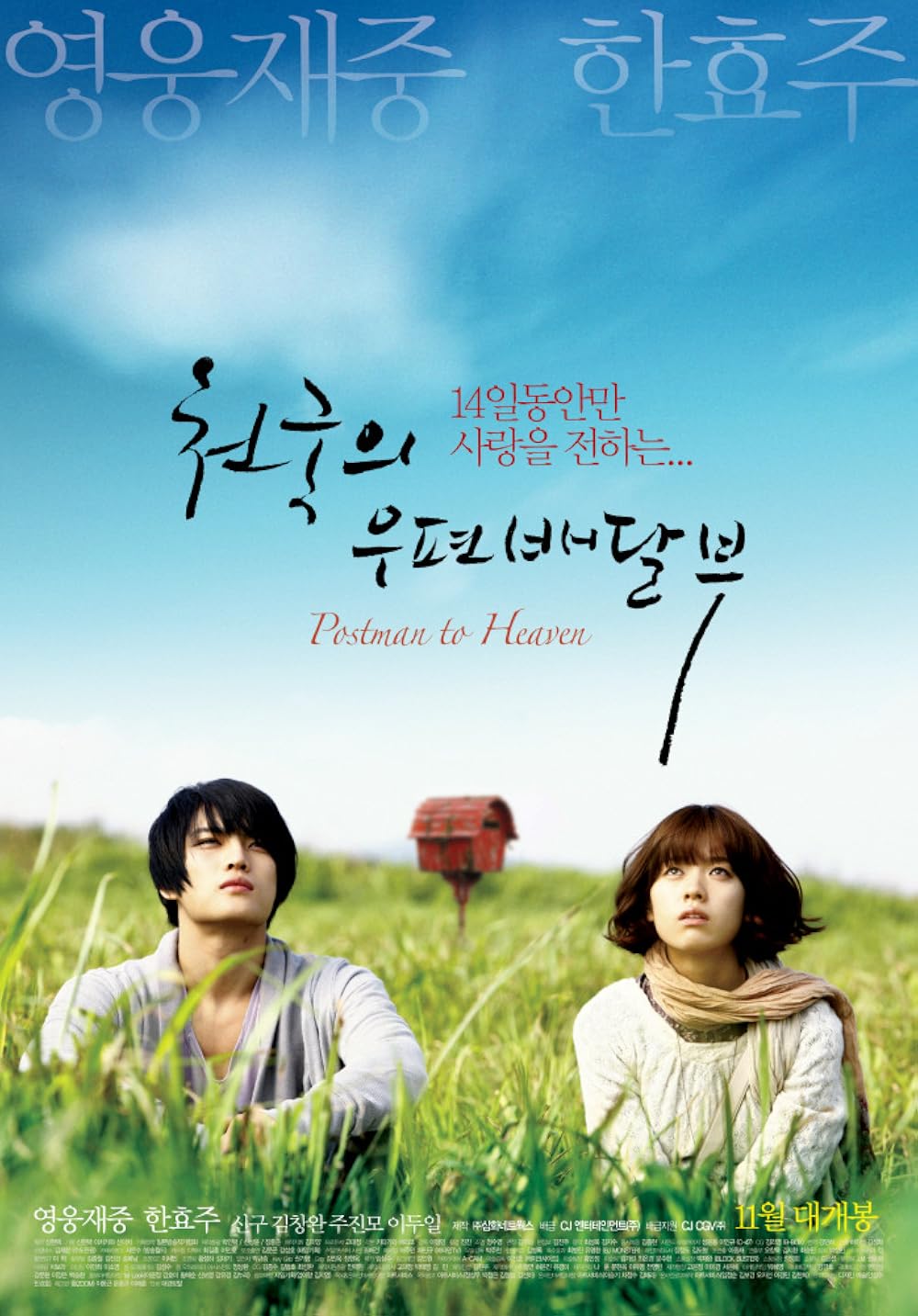
Working my way through Han Hyo-joo’s filmography, one of the things that has surprised me most is how differently the same actor can land from one film to the next. I loved the emotional intensity of Always, the unusual story of W, and the relationship tangled up with danger in Illang: The Wolf Brigade. Postman to Heaven, despite its intriguing premise, is a film I struggled to get into.
Credits
Original title 천국의 우편배달부 (Heaven’s Postman)
Year / Country 2009 · South Korea, Japan
Director Lee Hyung-min
Screenplay Eriko Kitagawa
Cast Kim Jae-joong, Han Hyo-joo, Shin Goo, Kim Chang-wan
Genre Drama, romance, fantasy
Runtime 107 minutes
The starting point is strong. People who couldn’t say what they needed to say to the ones they lost put it into letters and drop them into a mailbox standing in the middle of a green field. A mysterious postman, and the young woman who joins him, try to ease the pain of those left behind. There is plenty of material here for a moving story about grief, regret, forgiveness and learning to love again. My problem began with how that material was turned into scenes, and into the relationship between the characters.
Their first encounter and the way they get to know each other felt rushed to me. The conversations meant to bring them closer weren’t effective enough at building a real bond. At the same time, the overall pace was quite slow. The result is a strange imbalance: some of the key steps in the relationship fly by, while the parts I expected to draw me closer to the characters dragged. I kept checking how much time was left.
The acting didn’t close that distance either. I found Kim Jae-joong’s performance flat in most scenes. I understand a mysterious character playing things restrained, but here that restraint sometimes read as a lack of emotional response. Han Hyo-joo’s performance also fell short, for me, of some of her roles in later years. I never reached the emotional connection she managed to build in Always.
The hair and costume choices made it harder for me to warm to the characters, too. Jae-joong’s long hair, showy accessories and hard-edged outfits kept pulling my attention away from the story. I also found Han Hyo-joo’s hairstyle less successful than her look in her other films. These are personal tastes, of course. But in my experience of watching it, they made me notice the visual design built on top of the characters more than the characters themselves.
Spoilers ahead · click to open
There’s a more serious problem in how the story moves forward. Whenever the fake documents and recordings the characters prepare are needed, the solution is to turn to the same technically skilled person. Introducing that person early on does lay some groundwork. Still, having every new problem solved through him turns into an overly convenient fix that the script reaches for whenever it gets stuck.
The scene where a father listens to the voice of his dead son is the clearest example. I understand what the scene is going for emotionally. But the film never explains where the sample came from to create a recording the father would accept as his own son’s voice. Having someone who does audio work around doesn’t fill in that missing step on its own. So while I was trying to share what the father was feeling, I kept wondering how the recording was made.
This is where the film’s really interesting question comes up. How far can a lie told to comfort a grieving person go? How does a consolation that isn’t rooted in truth change someone’s relationship with their own pain? Whenever the film got close to that conflict, it felt stronger. I just wish the side stories had been set up with the same care.
The question of visibility, meanwhile, made me question the rules of the film’s fantasy world. We’re told that Jae-jun can only be seen by people who are mourning someone they lost. Yet in the first café scene, the waiter confirming that she sees him goes unexplained. It’s possible the waiter has lost someone too, but the film never shows it. So rather than calling it an outright contradiction, it’s more accurate to say an important detail is left to the viewer’s assumptions.
The final reveal that Jae-jun was in a coma, and his return to his body, is acceptable within the film’s fantasy logic. Even so, I have to say his return and the reunion that follows didn’t feel sufficiently set up. While delivering the emotional reunion, the film rushes through some of its transitions. The last stretch moved me more than what came before, but it didn’t fully resolve the questions left behind.
When I looked at other reviews, I found echoes of my impressions about the slow pace and the acting. The UnitedKpop review also finds Jaejoong’s early performance flat, but attributes it to the character’s air of mystery. The same piece notes that the film asks for patience, and considers the turn at the end a success. In my experience, though, the distance created early on limited the impact of the ending.
Audience reviews on Rotten Tomatoes are split, too. Alongside people who found it emotional and beautiful, there are those who found it slow or felt the story didn’t live up to its idea. I can understand that divide. The way the film approaches people searching for comfort may be enough for some viewers. I was hoping for scenes and relationships built solidly enough to carry that feeling.
While watching, I was planning to give it a four. The emotional impact of the final part nudged my rating up a little. Still, Postman to Heaven is one of the Han Hyo-joo films I’ve seen that reached me the least. What stays with me is a lovely idea about coping with loss, and the sense that it could have been told far more convincingly.
What worked for me
- A strong premise about grief, regret and consolation
- The question of how far a comforting lie can go
- A final stretch that hits harder than the rest
What didn’t
- A rushed first meeting against a slow overall pace
- Flat performances that never close the emotional distance
- Hair and costume choices that pull focus from the story
- An all-too-convenient helper character and details left unexplained
It was hovering around a four; the emotional pull of the ending lifted it a little.